Showing posts with label nature's harmony farm. Show all posts

Wednesday, October 27, 2010

The Problem With Pork

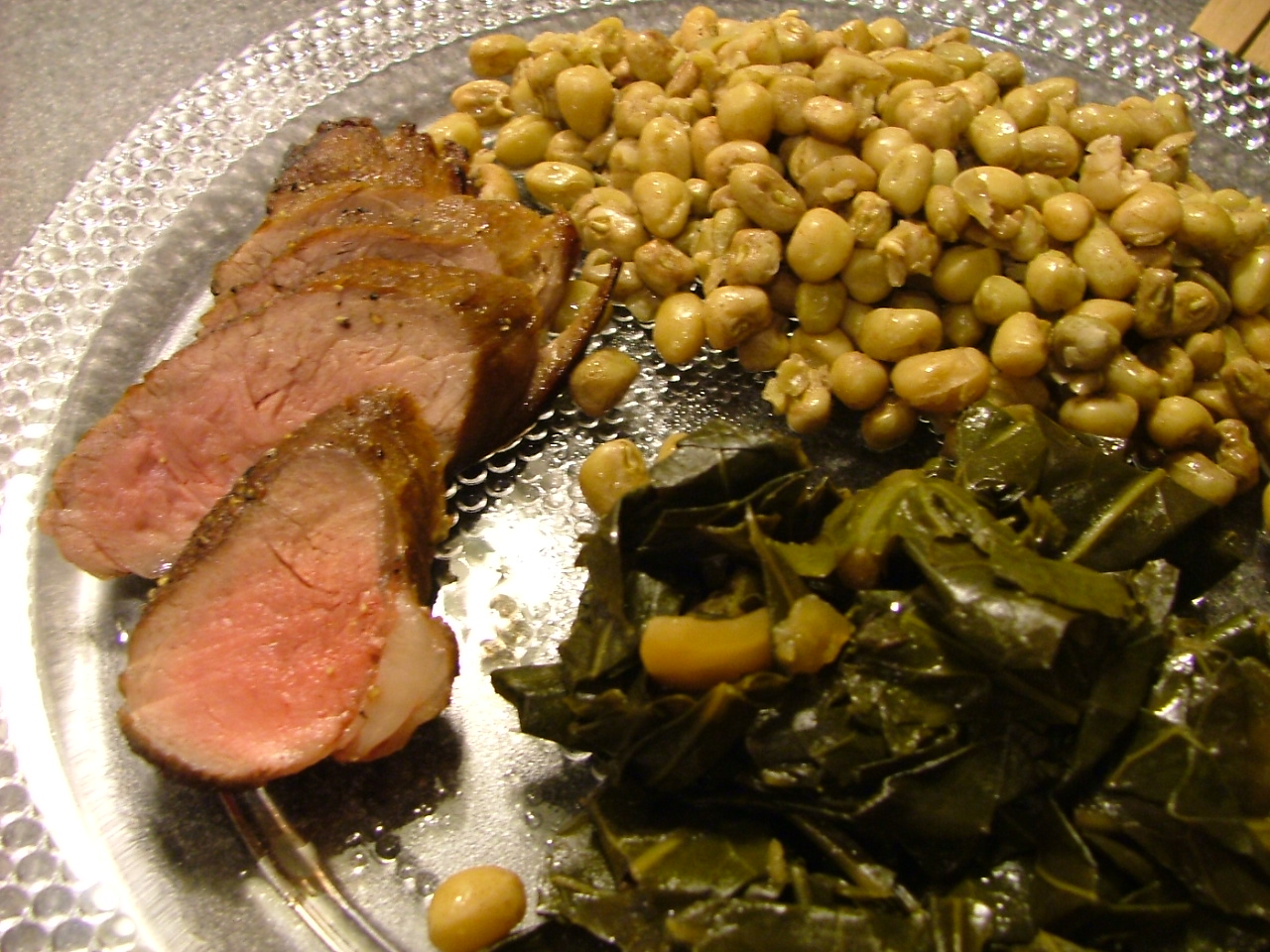
 Not a great picture... but hey, it was a great dinner. Ossabaw pork tenderloin, cooked to a rosy medium from Nature's Harmony Farm.

I'll preface this post by saying that though backed by a few factual bits, most of this post is editorial.  

Most people have had a pork chop.  Unfortunately many of those same people have had bad pork chops.  It's not the pigs fault really, or even the cook's fault to some extent, it is the sCaRy trichina worm.  Trichinella spiralis to be specific.  I along with millions of other home cooks, were raised with the thought that you had to cook pork thoroughly to kill this parasite.  It just isn't true.  Fortunately for those of you reading this, you can rest assured that I will help dispel this myth and help you cook a better pork chop.

Let me back-track a bit.  Trichinosis was at one time a more significant concern than it is today.  In decades of yore (let's say my grandparent's generation), the pigs that were raised for human consumption in factory farms were fed garbage.  Food scraps, waste from restaurants, waste from food processing plants, and other tasty bits.  Of course because they were pigs they didn't much care: if it was tasty, well then that was just fine.  Trichinosis infection in people was somewhat common.  According to my trusty interwebs netpages research, approximately 1 in 6 people were infected in the 30's and 40's.  Today the pigs are still fed food scraps, but those scraps are cooked.  Let's call it gourmet garbage, because cooked rotting beef parts and banana peel just sounds so much more appetizing.  Partly as a result of this cooking, there has been a significant drop of trichina worms in pigs raised for consumption during my parent's generation.  We'll call this the 50's and 60's.  This paragraph is where I should include a reference or two but hey, it's a blog not a research paper...  Just trust me. 

Old habits die hard.  You can't expect people to change their cooking habits overnight, things like this take time.  How 'bout we give people 60 years to rid themselves of the nasty habit of mercilessly overcooking pork?  Done... and here we are today.  Today we live in a world where pork raised in the US is virtually free of the trichina worm.  Even if the parasite was present in pork, the US Department of Agriculture says that it is killed in under one minute at a temperature of 140 degrees F.  At 140 degrees F commercial pork is often rosy pink and still relatively juicy depending on the cut, but in my experience there is a narrow window where this pork is done perfectly.  Because of the lack of fat in commercial pork, going too far above 140 F and you can end up with that dreaded, dry hockey puck.

So now we have a new problem.  While we were eliminating the parasites found in pork, we were also breeding the fat (and thus flavor) out of the meat.  The perception was that leaner is better.  The National Pork Board is proud of this fact.  They often compare it to lean poultry when in actuality pork shouldn't be all that white or lean to the point where it has virtually no intramuscular fat.  Real pork - pork with flavor - is varying shades of dark pink or red.

For a long time, pork fat was the enemy.  The rain on our pork parade.  While we shouldn't gorge ourselves on pure pig fat (please kindly disregard my previous posts on Lardo di Arnard), there is a silver lining to that porky rain cloud.  The fat in some pork, especially pastured or true, free range pork, rivals the levels of heart healthy oleic acid found in olive oil.  Doesn't sound too bad does it?  What if you heard that pork fat was lower in saturated fat than butter?  It is.  The pastured pigs found at an ever increasing number of farms dine on natural forage.  Nuts, acorns, tubers, bugs, etc.  This natural forage and the ability to roam freely (within reason of course) on wooded pasture is what lets pigs be happy and healthy.  A happy and healthy pig produces happy and healthy meats for the consumer.

Now where can you, the "average consumer" find this pastured pork?  You could take the time to drive out to a farm, talk to the folks who raised it, see the environment in which it was raised, ask a few questions, and eventually buy some pork and trek back home.  Seriously, I would recommend it - but in reality not everyone has the time or the desire to do such things.  We want convenience.  So what if that same farmer instead came to your town and delivered that pork to you?  Would that be convenient enough?  You're in luck.  How about you check out the new Farm Train from Nature's Harmony Farm.  It is an easy way to buy direct from the farm on a fairly regular basis.  Just go to the link above or visit Nature's Harmony website and enter your email address in the bottom right corner.  They will notify you of upcoming deliveries and send you an email when it's time to buy.

Go getcha some.

Oh they have chicken (and eggs), beef, cheese, lamb, rabbit, heritage breed turkeys and other meats too but perhaps those belong in a different post.

Monday, March 29, 2010

Lardo di Arnad: Part 2

Back in late December I started the process of curing a hunk of fatback from what I later determined to be an Ossabaw hog.  The fatback came from Nature's Harmony Farm of course... would you expect anything different at this point?!  Originally I was going to cut the fatback into smaller pieces to make lard, but Jason who I'll call an expert on the subject of curing meats, suggested that I make Lardo di Arnad.  So I did.  
The process was relatively simple: boil some water, dump in some salt and spices and, once it was cool, toss in the hunk of fatback.  I guess the hardest part was waiting the 3 months for it to cure.  The result?  At first I must admit I was skeptical.  The water had turned a dark brown (see above) and it smelled quite strong.  Kind of like spices sitting in salty water for 3 months with a hunk of fatback.  So I cut off a piece, toasted some homemade bread and laid thin slices of the Lardo di Arnad on top of the hot toast to partially melt (see below).  Holy crap this is good stuff.  Salty, silky, and hugely flavorful with a wonderful pork flavor.  I'm quite pleased with the results. 
So far I seem to be the only one in this house who eats the stuff... and I've got lots.  Come on over and try some.

Monday, March 15, 2010

Hog Butchering Class at Nature's Harmony Farm

Early Saturday morning I set out on a day trip to Elberton, Georgia to visit friends and farmers Tim & Liz Young at Nature's Harmony Farm.  This visit was quite different from past visits: this day we butchered half a Berkshire hog raised on the farm!

When I started telling people about the event, their visceral first reaction was to think we were actually killing the hog.  This was not the case; the killing was done a couple days prior to our arrival to allow for hanging time and minimal processing like removing hair, taking out the internal organs and bisecting the hog into two halves.  Below is the half hog just before we started.
The class began with lessons on how to render lard, how to make bacon, and how to use some of the less-used cuts of pork like the head.  Tim explained the simple curing process for bacon and then we sawed off the hocks, all of which were placed in the smoker.  Liz then showed us how she took the head to make porchetta di testa: a deboned, rolled, and cooked pig's head.  Of course they were nice enough to share and we were more than happy to taste test.  Everybody likes bacon, but the real treat was the porchetta di testa - good job Liz!
 Removing the hock
 
 Tim putting cured pork belly in the smoker to make hickory smoked bacon.

For more information on porchetta di testa, check out the video below.


Around noon we took a break for a farm tour and a quick bite to eat, then class resumed - now it was time to get down and dirty.  There are a few different schools of thought on what constitutes a section or primal of a hog, but today we focused on three sections: the shoulder, the loin and belly, and the ham.  These primals are further broken down into smaller cuts that are more recognizable: the shoulder was separated into the Boston butt and the picnic ham, the tenderloin was removed, the loin was sliced into chops, and while most everyone will recognize a ham, we cut into ham steaks to fairly distribute the meat among the 8 attendees.  Enjoy a few pictures.
Check out video that Tim and Liz put together of the day's events.


The class was really fantastic.  While most of us were generally familiar with what cuts come from what part of the pig, actually breaking down this half of a hog was an amazing learning experience.  There are several more classes this year that include chicken, lamb, and turkey butchering, as well as meat curing and cheese making classes.  Details are here if you're interested. Thanks Tim & Liz!

Monday, December 21, 2009

Lardo di Arnad

Below is a large hunk of skin-on fatback from either a Ossabaw or a "Crossabaw" (cross between a Ossabaw and Berkshire) from Nature's Hamony Farm.  Originally, it was destined to be rendered and turned into lard.  That was until a fellow poster at 285 Foodies suggested I should make Lardo di Arnad... I agreed.


So I have started the process which is really pretty simple.  According to Jason's instructions, I took 1 liter of water and brought it to a boil.  I used a bottle of spring water just to keep all the flavors super-clean.  Once the water boils, add 300 grams of salt and stir until dissolved.  Add in a hefty dose of herbs and spices and let the mixture steep until it is completely cool.  Here I have used about 8 grams of rosemary, 2 cloves of garlic (crushed), 7 juniper berries (crushed), a tablespoon or so of black peppercorns, 7 sage leaves, 6 whole cloves, 3 bay leaves, a stick of cinnamon, and a few small stems of thyme.  Once cool, pour the brine over the fatback and refrigerate... for a long time.  From here, time does the work.  Jason instructed to leave the fatback in the brine for 3 months, turning once a month, making sure everything is submerged.


So, you have 3 months to figure out what Lardo di Arnad is.  In 3 months (late March) I'll post again and of course show you the finished product.  Below is the fatback in the brine.


Saturday, November 21, 2009

Our 2009 Heritage Thanksgiving Turkey from Nature's Harmony Farm

Toms Struttin'

Earlier today we drove to Elberton, Georgia for another visit to Nature's Harmony Farm. Tim & Liz Young hosted turkey buyers from around the southeast for their second annual Turkey Harvest Day on the farm. As always it was great to see Tim, Liz and all the animals they have there.

We began with our electric alarm clock going off at about 7:00 am as opposed to the call and response of the farm's roosters at 4:30 am like last month. When we arrived after our 2 hour drive from Roswell, the Young's had music, cider, farm tours, and of course the guest of honor: heritage breed turkey. We picked out a 14.2 pounder which should be more than enough for the people we're feeding this year. Below are some pictures from our farm tour.

Toms & Hens

Now, why buy a heritage breed turkey versus a regular super market turkey? There is plenty of information out there on heritage breeds versus broad breasted white turkeys, but I think this New York Times article "About A Bird" from 2003 is a very good read. Please take the time to read it if you have not before; it will make you think twice about buying that supermarket turkey next year.

Aside from the ethical reasons, I think heritage breed turkeys simply taste better. I like to cook and whenever possible I seek out ingredients that are of the highest quality, especially for occasions like Thanksgiving. The meats from Nature's Harmony Farm certainly fulfill my needs. The turkeys, and all the animals at the farm, are pasture raised on grass where they are free to run around, scratch at the ground, and live a life that mimics nature as closely as possible.

For those of you who did buy a heritage breed turkey and now you're wondering how to cook it... be aware that these turkeys cook FAST. Last year we had a 13 pound turkey and it was in and out of the oven in about 1 hour and 15 minutes with an oven temperature of about 450F degrees. These birds are built very differently than a broad breasted white: the breast is much taller and elongated, and the legs and thighs are much bigger. That's what happens when a bird runs around on the farm as opposed to being cooped up in a poultry house. We followed this recipe which is similar (if not exactly the same) to the one Tim gave us when we picked up our turkey last year. Part of the reason that the turkeys are done sooner is because they are done at a lower temperature - or at least what is perceived as a lower temperature. I removed our bird from the oven when the thigh meat registered 150F degrees, and it probably should have come out at about 145F. While this might sound low, you have to take carry-over cooking into account which will take the bird into the 160+F degrees range. And, if you follow the USDA guidelines on cooking turkey you should only cook your standard grocery store bird to 165F degrees - not too much difference. The days of cooking turkey to 180F degrees are over, and whatever you do, DO NOT EVER use the plastic pop-up timer to determine the turkey's doneness. Your best tool for keeping track of the turkey's temperature is a probe thermometer.

So while it might be a little late to seek out a heritage breed turkey for this Thanksgiving (Nature's Harmony takes deposits and sold out months ago) keep an eye out for next year, I think you'll be pleasantly surprised with the taste and you just might feel a little better about what's on you plate.

Mom & Piglets seen on the tour.

Sunday, October 18, 2009

Pork & Beans


Don't worry this is gourmet pork & beans...

Today is our first wedding anniversary so how do we celebrate? Pork and beans of course! This is real, homemade pork and beans with white beans soaked and cooked in homemade chicken stock and braised (fresh, not smoked) pork/ham hocks form Nature's Harmony Farm. Noticing a trend with these last few posts? This pork was superb - full of flavor which was only enhanced by the chicken stock, garlic, and rosemary.

Happy anniversary, sweet pea!

Wednesday, October 14, 2009

Poulet Rouge from Nature's Harmony Farm

If you cook whole chicken on a regular basis you will probably notice something different in the pictures below. The pictures show a chicken with a smaller, thinner breast and longer legs when compared to a typical supermarket chicken. Now, small breasts aren't always desirable in all aspects of life, but this is a chicken... get your mind out of the gutter! This is a Poulet Rouge (French for Red Chicken) from Nature's Harmony Farm. What is the difference aside from the appearance? For one, they are older chickens: typically twice as old (or more) than a standard supermarket chicken. They are a slower growing, hardier breed of chicken. They are also raised differently. As opposed to being raised in a packed, overcrowded chicken house, the chickens at Nature's Harmony are raised on pasture. To read more about how Nature's Harmony Farm raises their Poulet Rouge chickens, click here.


Aside from the standards by which they are raised, I can tell you based on first hand experience that these Poulet Rouge chickens are an amazing change from what is often bought at the supermarket. The end result is a chicken that is full of flavor, moisture, and texture. Far more flavor than what you are probably used to. If you have the chance to purchase a Poulet Rouge chicken, by all means buy it! I'm certain that you will be pleasantly surprised at the difference. Shown below is a finished roasted chicken over a bed of turnip greens, fresh out of the oven.

Monday, October 12, 2009

Dinner on the Farm


Saturday 10/10/09

Leaving Atlanta on Saturday morning under threat of rain, Liv and I attended the "Local Food Campout" at Nature's Harmony Farm in Elberton, Georgia. We had to trust that the food gods would smile on us instead of... spit? Anyway, we weren't spit on - not even one drop. The following is a brief overview of our wonderful Saturday and Sunday on the farm.

The event was a celebration of local food both from the farm itself and from other local farms like Full Moon Farm which provided seasonal organic vegetables and cheese from Split Creek Farm. All the food was exquisitely prepared by Chef Hugh Acheson and his team. Check out the menu further down in the post. Aside from the food, there were ample adult joy beverages from Terrapin Beer and wine from Boutier Winery gracing the tables.

This was our second visit to the farm. Our first visit was in 2008 when we bought our Thanksgiving turkey from Tim and Liz Young. This November we're headed out to the farm for our celebratory turkey again... we can't wait! Below is a short video of some turkeys gobbling and the males strutting their stuff - notice the fluffed and fanned feathers on the toms (males).


Upon arrival in Elberton we set up our tent in the pasture. The farm tour would begin soon and we wanted to make sure we had our humble abode set up for the night. The farm's designated tent inspector made sure that everything was up to par.

Farm's Designated Tent Inspector

The tour was an all inclusive look at how the animals are raised and cared for. Tim and Liz are committed to animal welfare above all else and raising the animals in an environment that mimics nature as closely as possible. The results are some of the best tasting meats I've ever found. To read more about Nature's Harmony farm values, click here.

Speaking of, what animals are raised at Nature's Harmony Farm? Poulet Rouge chickens and other pasture raised chickens, grass fed beef, grass fed lamb, naturally raised wood lot pork (including Berkshire, Ossabaw, and Large Black), heritage breed turkeys, heritage breed geese, and ducks. Oh, and they have a few honey bee boxes on the property too. Suffices to say they and their 3 apprentices have their hands full. One of the most interesting stories (and tastiest dishes of the night) was the story of the Ossabaw Island pigs. If you are at all unfamiliar with Ossabaw Island pigs, I encourage you to click on this link. It is a blog post by Tim at the farm and gives the history behind this very interesting and very rare breed. Below are several pictures of the animals that were taken on the tour.

Pollyanna, a Murray Grey Calf born on 9/28/09. Pictured here she is only 12 days old!

Cattle relaxing in the pasture.

Pollyanna stealing the spotlight, with lamb and cows in the background.

Ossabaw Island Pig (picture #1)

Ossabaw Island Pig (picture #2)

Ossabaw Island Pig (picture #3)

Naked Neck chickens raised under Poulet Rouge standards.

Pasture raised ducks

Berkshire Pigs

Heritage Geese

Narragansett Turkey

After the tour was over it was time for dinner! Chef Acheson (green shirt) prepared a killer multi-course dinner for 100+ people.


Menu for 10/10/2009

Passed hors d'oeuvres

Pimento cheese sandwiches with pickled okra

Deviled egg salad with caviar


Chilled sweet potato soup with chive cream


On the table

Roasted beets with avocado, Split Creek feta, and arugula

Tians of eggplant, sweet peppers, and basil and Split Creek goat cheese


Savory swiss chard tart


Red Mule polenta with melted leeks


Grilled Nature's Harmony Farm Ossabaw pork chops with agrodolce


Roasted Nature's Harmony Kathadin lamb leg with salsa verde


Nature's Harmony Poulet Rouge chicken bog over rice


Pumpkin and pecan pie


Following dinner was a warm bonfire and lively music from the North Georgia Bluegrass Band. The food and company was really, really great and Liv and I enjoyed every minute of it. After the band was finished, it was time for bed.


Sunday 10/11/09


Morning on the farm comes early, especially with what seemed like hundreds of roosters cock-a-doodle-dooing at sunrise. For anyone who thinks roosters don't cock-a-doodle-doo when the sun comes up, you can kiss my ass... they do. Jokes aside, the wake up call was fully expected considering we were sleeping only several yards from the chickens. After we opened the tent and saw the cool morning mist and the animals up and about, we put on our shoes and walked the farm watching some kids help with morning chores before breakfast.

Sunrise over Nature's Harmony Farm

Awake Yet? This was my first view when I unzipped the tent.

Breakfast was pancakes with honey right from the farm's bees and sausage made from the farm's pigs. Tim took the helm and made everyone a wonderful breakfast.

Honey bees hard at work.

Thanks to the apprentices (Mario, Kerry & Amanda), Chef Hugh and his team, but most importantly Tim and Liz for a wonderful weekend. We look forward to similar events in the future and if you are interested in attending tours or events, or simply want to learn more about the farm, visit the website and blog by clicking here.

See a great video recap that Tim and Liz put together (below), and check out Tim's blog post about the event here.


Monday, December 1, 2008

Heritage Turkey for Thanksgiving

Me in the AJC!

Bourbon Red Turkeys

Photos by Jamie Gumbrecht


This year for Thanksgiving we got an extra special bird. We bought a heritage breed turkey from Tim & Liz Young of Nature's Harmony Farm in Elberton, Georgia. If you don't know what a heritage breed turkey is, search for it in Google - there's plenty of info out there. Tim and Liz are new to the farming scene but they are most certainly doing great things. I won't simply repeat all the newspaper info, but if you're interested in reading more about these guys, visit their website above or check out this AJC article here.